
What do you want to learn from your graph: its connectivity, its
edge-length geometry, or how a drawing compares with a known reference?
Start with that question. grip() computes a drawing;
scoring, tracing, and graph-family helpers support different decisions
around that drawing.
Choose a starting point
| Your question | Entry point | Follow-up |
|---|---|---|
| What does the connectivity look like? | grip(metric = "hop") |
Getting Started |
| What if edges have meaningful lengths? | grip(metric = "edge_length") |
Weighted Graph Layouts |
| Which settings and seeds give useful drawings? |
compare.layouts(), then
params.from.summary()
|
Choosing Layouts for Real Data |
| Does my drawing preserve graph distances? |
score.layout() or the more specialized
score.gmds()
|
Choose a score |
| Does it recover a reference configuration? |
score.coordinates(); score.surface() for
triangular surfaces |
Synthetic graph examples |
| Where did a fold or collapse appear? | trace.grip() |
Tracing and Diagnosing Layouts |
| How do I construct a reproducible example? | An edges.*() generator or a complete
*.graph() bundle |
Synthetic graph families |
| How do I browse many saved results? |
gripui_project() and run_gripui() in an
interactive session |
Website explorer article |
The six linked package vignettes are installed with grip. The gallery, comparison article, and interactive explorer are website-only articles.
A first drawing and diagnostic
Here 20 vertices form a rectangular grid. Sampled stress measures how well Euclidean separation in the drawing matches shortest-path hop counts after fitting a common scale. Zero means perfect agreement on the evaluated pairs; it does not certify that every geometric feature or unsampled pair is correct.
library(grip)
edges <- edges.mesh(4, 5)
coords <- grip(edges, n = 20, dim = 2, preset = "mesh", seed = 11)
stopifnot(identical(dim(coords), c(20L, 2L)), all(is.finite(coords)))
plot.layout(coords, edges = edges, pch = 16, cex = 0.7,
            main = "A 4 by 5 mesh")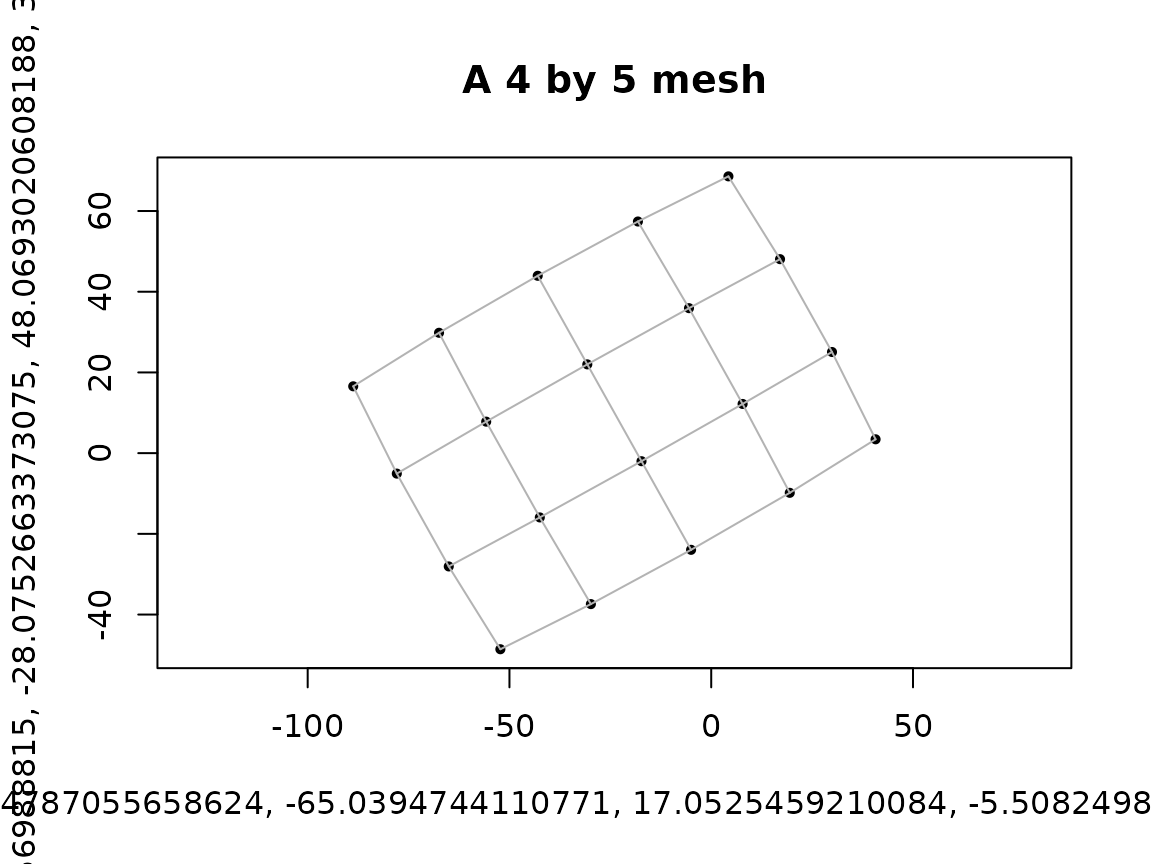
quality <- score.layout(coords, edges = edges, n = 20,
                        sample.size.stress = 200, stress.seed = 11,
                        edge.crossings = "never")
knitr::kable(quality[, c("sampled.stress", "edge.length.cv")], digits = 3)| sampled.stress | edge.length.cv |
|---|---|
| 0.138 | 0.062 |
The edge-length coefficient of variation
(edge.length.cv) is the standard deviation divided by the
mean of drawn edge lengths. It describes their uniformity, which is
useful here because the graph is unweighted. Unequal lengths can be
intentional on other graphs.
Input and output conventions
Supply an undirected edge list as a two-column matrix of
1-based integer vertex indices, one edge per row.
Supply n explicitly when the highest numbered vertex is
isolated, when the edge list is empty, or when a generator has a known
vertex count. Inferring n = max(edges) cannot recover
isolated vertices beyond the largest endpoint. Avoid duplicate edges and
self-loops; the edge-list layout converter ignores self-loops, and
duplicate treatment is not a common contract across all helpers.
Alternatively use adj_list, a list of length
n: element i lists the neighbors of vertex
i. Include both directions of each undirected edge, with
matching lengths in a parallel weight_list. An isolated
vertex has an empty neighbor vector (and empty length vector if
weighted). Do not supply both graph representations: this is an error,
as are fractional or nonfinite vertex indices and counts. Supply lengths
with their matching representation (edge_weights with
edges, or weight_list with
adj_list). Preserve the same vertex ordering in graph,
coordinates, labels, and references; row names do not establish
correspondence.
grip() defaults to dim = 3; request
dim = 2 explicitly for base 2D plots. It returns an
n by dim numeric matrix. By default
disconnected components are laid out separately and packed into that
matrix, including isolated vertices. Their relative positions are
display choices, not finite distances between components. Set
disconnected = "error" to reject such inputs. Sampled
graph-distance stress uses reachable pairs; full all-pairs geodesic
preparations require a connected graph. Split components before using
them.
Hop counts or edge lengths?
The historical names edge_weights and
weight_list mean finite positive lengths or
traversal costs, not connection strengths. With an edge list,
edge_weights[j] belongs to row j. Larger
lengths request greater separation; convert strengths to scientifically
meaningful lengths before fitting.
-
metric = "hop"uses hop counts for the standard hierarchy, neighborhoods, and insertion anchors. If lengths are supplied, they still set adjacent-edge attractive-force targets, without global normalization. Omit lengths for a purely unweighted baseline. Optional landmark-geodesic refinement stages use supplied lengths even when the standard stages use hops. -
metric = "edge_length"requires lengths and uses sums of those lengths along shortest paths throughout the multiscale engine. Its defaultlength_normalization = "median"divides by the median length;"mean"divides by the mean and"none"retains their numerical scale. These normalization controls andmetric_neighbor_capbelong only to this mode. A finite neighbor cap enables an approximate weighted search.
A graph-family constructor may already normalize lengths: inspect its
weight_scale and normalize fields before
choosing solver normalization. score.layout() has no
metric argument: it uses weighted shortest paths when
lengths are supplied and hops when they are omitted, independently of
how the drawing was fitted.
Dimensions, result objects, and methods
| Operation | Coordinate dimensions and result |
|---|---|
grip(), global-repulsion variants, legacy layouts |
2 or 3 columns; coordinate matrix. |
weighted.grip.nd() |
At least 2 columns, including dimensions above 3; weighted multiscale layout matrix. Opt in explicitly. |
classical.mds(), metric.mds(),
edge.kk()
|
Support higher dimensions (MDS dimension must be smaller than vertex
count); list of class grip_gmds_layout, with
$coords, $diagnostics, $metadata,
and method information. |
score.layout(), full/landmark/MISF geodesic-KK,
kernel.gram.gkk() and local-star tools |
2D or 3D workflows; do not infer higher-dimensional support from the MDS interfaces. |
score.gmds(), score.coordinates()
|
Higher-dimensional matrices supported; corresponding-coordinate inputs must have identical shapes. |
score.surface() |
Three-column coordinates plus explicit triangular faces for each surface. |
trace.grip() |
List with $final, $frames,
$meta, and $diagnostics; frames have 2 or 3
columns. |
plot.layout(), project.3d()
|
2D drawing or a view of the first three coordinate columns; additional columns are ignored, not fitted into a new layout. |
Use plot.layout(coords, edges = edges) on the ordinary
matrix returned by grip(). The registered plot.layout method
is also dispatched by plot() on an object with class
"layout"; grip’s ordinary matrix does not acquire that
class. plot() alone on a matrix is not the graph plotting
workflow.
Call print(fit) on a grip_gmds_layout to
see its method
summary, then plot fit$coords. Call
print(hierarchy) on the grip_misf returned by
build.misf() for its hierarchy summary. These
are the other two S3 registrations; they are not additional exports.
build.weighted.misf() returns its documented hierarchy list
and does not share that print method. Full and landmark geodesic-KK
refinements return lists with $coords, $score,
and optional traces, not ordinary matrices.
For static 3D figures, always request
projection = "ortho" in plot.layout(). Its
default 3D route uses optional rgl interactively.
project.3d() rotates the first three columns and returns
two projected columns. Score the original coordinates to assess the
fitted layout; scoring the projection answers a different question.
A common extraction step
layout.coords()
returns the original coordinate matrix from a matrix, trace, MDS fit, or
supported refinement result. It preserves vertex order, dimensions,
names, and values; it does not align or project results. Use the same
graph when scoring the extracted matrices:
small.edges <- edges.path(6)
fits <- list(
  ordinary = grip(small.edges, n = 6, dim = 2, seed = 1),
  trace = trace.grip(small.edges, n = 6, dim = 2, seed = 1),
  classical = classical.mds(edges = small.edges, n = 6)
)
matrices <- lapply(fits, layout.coords)
vapply(matrices, function(z) score.layout(z, edges = small.edges, n = 6,
  sample.size.stress = 15, stress.seed = 1,
  edge.crossings = "never")$sampled.stress, numeric(1))
#>     ordinary        trace    classical
#> 1.820825e-02 1.820825e-02 2.237461e-16
# Plot any extracted matrix with the same graph:
# plot.layout(matrices[[1]], edges = small.edges)
Direct $final and $coords extraction
remains supported. In MDS results, method,
coords, diagnostics, and metadata
remain available; stopping metadata depends on the method. Prepared
caches and coordinate-dependent state are internal/version-dependent and
should be rebuilt when their contract changes. The accessor rejects
unknown lists and ambiguous results instead of guessing a field.
Classical scaling and metric stress MDS
classical.mds() runs stats::cmdscale() on
graph shortest-path distances. Classical scaling approximates the
double-centered squared-distance (Gram) matrix by a low-rank Euclidean
representation, usually called minimizing strain. It does not
directly minimize the sum of squared distance residuals. Non-Euclidean
graph distances can yield negative eigenvalues; add and
eig are controls of this classical method.
metric.mds() minimizes unweighted raw distance stress,
,
through optional smacof. Edge lengths determine the
shortest-path targets, not pairwise stiffnesses. Returned coordinates
are rescaled to the input distance units. Multiple starts can help with
local optima; iteration limits do not certify convergence or a global
optimum. init accepts "classical",
"random", or a coordinate matrix; n_init
includes the first start. A non-NULL seed preserves the
caller’s R random-number state. scale_mode changes
diagnostics only.
In versions through 0.2.0, metric.mds() performed
classical scaling. Use classical.mds() to retain that
behavior, including add and eig. See the MDS migration help.
prepared <- prepare.graph.geodesic.mds(edges.cycle(8), n = 8)
classical <- classical.mds(prepared = prepared, dim = 2)
print(classical)
#> <grip_gmds_layout>
#>   method: classical_mds
#>   vertices: 8  | dimensions: 2
#>   objective: classical strain (direct classical scaling)
#>   convergence: not applicable (direct scaling)
#>   graph diagnostics (scale policy: profiled):
#>     edges: 8  | retained pairs: 28
#>    edge target-normalized RMSE: 2.54384e-16
#>    retained-path target-normalized RMSE: 1.48292e-16
#>    chord target-normalized RMSE: 0.140717
#>   extract coordinates: x$coords; diagnostics: x$diagnostics
if (requireNamespace("smacof", quietly = TRUE)) {
  metric <- metric.mds(prepared = prepared, dim = 2, n_init = 2,
                       max_iter = 100, seed = 11)
  metric$metadata$raw_stress
} else {
  message("Install smacof for metric stress MDS; the classical example still runs.")
}
#> [1] 3.417361
Choose a score
A chord is the Euclidean separation between two drawn vertices. A path length adds the drawn lengths of consecutive graph edges along a retained route. A folded chain can preserve its path length while bringing its endpoints close together. These measurements answer different questions.
| Question | Score and targets | Alignment, scale, and units |
|---|---|---|
| Is the drawing useful without a reference embedding? |
score.layout(): sampled chords versus shortest graph
distances, edge-length variation, non-neighbor separation, and optional
2D crossings or clusters. |
Sampled stress fits one scalar and is dimensionless. Edge CV and separation ratios are dimensionless; crossing counts are counts. Sampling seeds and sizes affect the result. |
| Are local lengths, retained paths, and endpoint separations faithful? |
score.gmds(): separate edge, fixed-path, and chord
residual panels on a prepared graph. Path targets follow its
retained-route convention; they may differ slightly from strict
distances near ties. |
"profiled" fits a separate scale per panel;
"identity" fixes one; "user" supplies panel
scales. Relative RMSE is dimensionless; absolute RMSE is in
drawn-coordinate units against scaled targets. No coordinate-reference
alignment. |
| Did corresponding vertices recover particular coordinates? |
score.coordinates(coords, reference): root mean squared
Euclidean vertex displacement. Rows must correspond. |
Default rigid alignment allows translation, rotation and reflection.
allow_reflection = FALSE forbids reflection. Similarity
also fits uniform scale; "none" uses the supplied
alignment. RMSE is in reference-coordinate units; relative RMSE divides
by the reference RMS radius. |
| Do two already aligned triangular surfaces occupy the same region? |
score.surface(): area-weighted, symmetric RMS
closest-point distance to triangles, estimated by sampling each surface.
Different meshes are allowed. |
No alignment, scaling, or triangulation is performed. Output has coordinate-distance units. Its Monte Carlo standard error measures sampling error, not mesh or alignment uncertainty. It is not a maximum-distance measure. |
The geodesic-KK scorers use their own path objectives, stiffnesses, and scale policies. Their values are not interchangeable with sampled chord stress, metric-MDS raw stress, or reference errors. Compare layouts using the same graph, lengths, vertex order, samples, preparation, scale policy, and score definition. Candidate composite scores are relative to their search and weighting choices, not universal quality grades.
Reuse preparations and control cost
| Preparation | What can be reused | When to rebuild |
|---|---|---|
prepare.edge.kk() |
Edges and targets for repeated edge repair and edge diagnostics; no all-pairs cache. | Changed topology, vertex order/count, or edge lengths. |
prepare.graph.geodesic.mds() /
prepare.geodesic.kk()
|
Connected-graph distances and retained routes for multiple coordinate candidates. | Graph changes, a new tie policy, or older caches predating the shortest-path symmetry fix. |
prepare.landmark.geodesic.kk() |
A sparse set of local and landmark routes. | Graph changes or new local-neighbor/landmark counts. |
prepare.misf.geodesic.kk() |
Multiscale independent-set filtration (MISF), level routes, and initializers. | Graph changes or changed hierarchy, tie, or initialization settings. |
build.misf() / build.weighted.misf()
|
Inspectable multiscale hierarchy, with the latter also storing weighted neighborhoods and anchors. | Changed graph, metric, seed, or construction controls. They are not
a generic prepared argument for grip(). |
Graph inputs must be undirected: adjacency entries have reciprocal entries with matching lengths and multiplicities. Self-loops are rejected; remove them before layout or preparation. Ordinary GRIP preserves parallel-edge multiplicity. Full and landmark geodesic preparations collapse parallel pairs in their canonical edge table; edge-only preparation rejects duplicate undirected edges. Simplify parallel edges explicitly before comparing these different workflows, particularly when their lengths differ. The validators do not silently simplify your input.
Treat preparations as immutable graph-specific objects. Do not
combine a prepared object with raw graph inputs
(edges, adj_list, edge_weights,
or weight_list); these calls fail rather than silently
choosing a graph. An explicit n must be an integer matching
the prepared vertex count. Rebuild the preparation to change the graph.
Coordinate candidates on the same graph may change without rebuilding
the graph cache; a state containing coordinate-dependent forces or a
local-star geometry must be recomputed when those coordinates
change.
Use estimate.preparation()
before a large graph-distance preparation:
estimate.preparation(10000, n.edges = 20000)
#>   n.vertices n.edges pair.mode pair.count.upper.bound
#> 1      10000   20000 all_pairs               49995000
#>   dense.distance.bytes.lower.bound dense.distance.GiB.lower.bound
#> 1                            8e+08                      0.7450581
This is a lower bound for one matrix, not a peak-memory prediction.
Dense preparations warn before graph searches when that bound exceeds
512 MiB. Set options(grip.preparation.warn.bytes = ...) to
a different positive byte count, or Inf to acknowledge and
suppress the advisory warning. Edge-only preparation has no dense
distance matrix. Landmark preparation still computes dense
distances; it reduces retained paths, not that storage
requirement.
Native construction/refinement checks for interrupts at main-thread boundaries. Threaded geodesic-MDS work joins its workers before raising an interrupt; cancellation may wait for the current evaluation and does not return a partial fit.
A dense distance matrix takes roughly 8 * n^2 bytes
before workspace and copies. Full route caches can cost much more,
depending on path lengths. Use diagnostics = FALSE with raw
inputs in the two MDS methods to avoid the full route cache; the dense
distance matrix is still required. Classical scaling also uses a dense
eigendecomposition. Landmark and multiscale preparations reduce retained
pairs or work on smaller levels, but their cost still depends on graph
searches and route lengths. Begin with GRIP, small candidate sets, and
level traces; retaining every round of a large solve can itself be
costly.
Experimental refinement and current initializers
Try the appropriate GRIP metric, a plausible preset, several seeds, and the scoring/tracing workflows first. Edge-KK, full geodesic-KK, landmark geodesic-KK, MISF geodesic-KK, repulsive stages, and kernel/Gram local-star tools are public experimental interfaces. Improving their objective need not improve a reference embedding or the readability of a drawing.
edge.kk() accepts supplied coords, or
init = "classical_mds" (default),
"metric_mds", "weighted_grip", or
"random". The MDS choices need all-pairs distances;
supplying coordinates or using a non-MDS start permits edge-only
preparation. The weighted-GRIP initializer uses the 2D/3D
grip() interface; supply higher-dimensional coordinates
directly for edge repair. kernel.gram.gkk() accepts
"classical_mds" (default), "metric_mds", or
"random", or supplied coordinates. Both methods now
interpret "metric_mds" as stress minimization requiring
smacof.
geodesic.kk() and landmark.geodesic.kk()
require starting coordinates. MISF preparation uses
top_level_init = "geometric", "cmdscale", or
"random";
misf.geodesic.kk(top_level_init = NULL) inherits the
prepared choice or defaults to "geometric". Its
"cmdscale" spelling still means classical scaling.
Initializer names are not a uniform package-wide vocabulary.
Function catalog
This guide covers 106 explicit public exports and three
registered S3 methods. plot.layout() is both
exported and registered, so there are 108 unique exported or registered
function names, not 107. The catalog gives each export exactly one row.
Methods selected by R’s generic functions are explained through their
objects below. Internal helpers and the compatibility aliases retired in
0.2.0 are not public entry points.
Each row below is one explicit export. Help opens
the detailed help page; in an offline R session use
help("function.name", package = "grip"). Shared help topics
may document several exports, but these rows keep their purposes
distinct. Maintainers can run make audit-api-guide to check
coverage, method accounting, and help targets against the current
namespace.
Compute layouts
| Function | Purpose | Details |
|---|---|---|
grip() |
Compute a multiscale layout using hop counts or positive edge lengths. | Help |
weighted.grip.nd() |
Compute a weighted multiscale layout in two or more dimensions. | Help |
classical.mds() |
Fit a classical-scaling baseline from graph shortest-path distances. | Help |
metric.mds() |
Minimize raw distance stress with optional smacof and multiple starts. | Help |
globalrep.grip() |
Use the explicit coarse-global-repulsion hop-layout interface. | Help |
globalrep.weighted.grip() |
Use the explicit coarse-global-repulsion weighted-layout interface. | Help |
legacy.grip() |
Reproduce the legacy GRIP profile for historical comparisons. | Help |
Select and compare candidates
| Function | Purpose | Details |
|---|---|---|
compare.layouts() |
Run candidate settings across seeds and summarize layout quality and stability. | Help |
params.from.summary() |
Recover reusable layout parameters from a comparison summary row. | Help |
Score graph distances or reference geometry
| Function | Purpose | Details |
|---|---|---|
score.layout() |
Evaluate sampled graph-distance fidelity and drawing-quality heuristics. | Help |
score.gmds() |
Report separate edge, retained-path, and chord diagnostic panels. | Help |
score.coordinates() |
Measure error against corresponding reference vertices with explicit alignment. | Help |
score.surface() |
Estimate symmetric area-weighted distance between already aligned triangular surfaces. | Help |
geometry.diagnostics() |
Compute reference-aware geometric diagnostics for trace frames. | Help |
Trace multiscale layouts
| Function | Purpose | Details |
|---|---|---|
trace.grip() |
Record multiscale frames and diagnostics under either graph metric. | Help |
trace.legacy.grip() |
Record frames from the legacy layout profile. | Help |
Plot and project
| Function | Purpose | Details |
|---|---|---|
layout.coords() |
Extract unchanged coordinates from supported result families | Help |
plot.layout() |
Draw a coordinate matrix and graph edges; also the registered plot method for class layout. | Help |
project.3d() |
Rotate and project the first three coordinate columns to a static two-column view. | Help |
Prepare graphs and inspect multiscale structures
| Function | Purpose | Details |
|---|---|---|
build.misf() |
Build the hop-distance maximal independent-set filtration used by GRIP. | Help |
build.weighted.misf() |
Build weighted multiscale levels, neighborhoods, and insertion anchors. | Help |
estimate.preparation() |
Estimate dense storage and retained-pair bounds without preparing a graph | Help |
prepare.edge.kk() |
Prepare edges and length targets without an all-pairs cache for experimental edge repair. | Help |
prepare.graph.geodesic.mds() |
Prepare connected-graph all-pairs distances and retained geodesic routes. | Help |
prepare.geodesic.kk() |
Prepare full retained routes for experimental geodesic-KK scoring and refinement. | Help |
prepare.landmark.geodesic.kk() |
Prepare sparse local and landmark routes for experimental refinement. | Help |
prepare.misf.geodesic.kk() |
Prepare multiscale hierarchies and per-level routes for experimental geodesic-KK. | Help |
Experimental refinement and state diagnostics
| Function | Purpose | Details |
|---|---|---|
edge.kk() |
Repair adjacent-edge lengths from a starting layout under edge stress. | Help |
edge.length.density.stiffness() |
Convert edge lengths to normalized spring stiffnesses for edge repair. | Help |
geodesic.kk() |
Refine supplied coordinates using full retained-path geodesic-KK energy. | Help |
score.geodesic.kk() |
Evaluate full geodesic-KK path error and energy. | Help |
landmark.geodesic.kk() |
Refine supplied coordinates using sparse local and landmark routes. | Help |
score.landmark.geodesic.kk() |
Evaluate the sparse landmark geodesic-KK objective. | Help |
misf.geodesic.kk() |
Compute a layout through multiscale geodesic-KK insertion and refinement. | Help |
score.misf.geodesic.kk() |
Evaluate a layout on a selected prepared MISF level. | Help |
edge.repulsive.state() |
Evaluate edge repair combined with repulsion at fixed coordinates. | Help |
edge.repulsive.stage() |
Optimize an edge-repair stage with repulsion. | Help |
repulsive.state() |
Evaluate the repulsion-only objective and gradient at fixed coordinates. | Help |
repulsive.stage() |
Optimize a repulsion-only stage from supplied coordinates. | Help |
graph.riemannian.star.structure() |
Build local reference-star geometry for kernel/Gram refinement. | Help |
kernel.gram.gkk() |
Refine a layout using edge stress and local kernel/Gram shape constraints. | Help |
Synthetic graphs: primitive edge generators
| Function | Purpose | Details |
|---|---|---|
edges.path() |
Return consecutive edges of a path. | Help |
edges.cycle() |
Return edges of a closed cycle. | Help |
edges.mesh() |
Return edges of a rectangular grid. | Help |
edges.cube() |
Return edges of a three-dimensional grid. | Help |
edges.cylinder() |
Return edges of a grid wrapped in one direction. | Help |
edges.torus() |
Return edges of a grid wrapped in both directions. | Help |
edges.kary.tree() |
Return a rooted tree with k children per internal vertex. | Help |
edges.sierpinski.carpet() |
Return occupied-cell adjacency for a Sierpinski carpet. | Help |
edges.sierpinski.triangle() |
Return a recursively subdivided Sierpinski triangle graph. | Help |
edges.sierpinski.tetrahedron() |
Return a recursively subdivided Sierpinski tetrahedron graph. | Help |
Synthetic graphs: configurable keep masks
| Function | Purpose | Details |
|---|---|---|
keep.periodic.holes() |
Create a finite-grid keep matrix with periodic holes. | Help |
keep.asymmetric.notches() |
Create a finite-grid keep matrix with asymmetric notches. | Help |
keep.slit.channels() |
Create a finite-grid keep matrix with slit channels. | Help |
keep.staggered.windows() |
Create a finite-grid keep matrix with staggered windows. | Help |
mask.border() |
Create a square recursive mask retaining its border. | Help |
mask.corner() |
Create a square recursive corner pattern. | Help |
mask.cross() |
Create a square recursive cross pattern. | Help |
mask.asymmetric.holes() |
Create a square recursive pattern with asymmetric holes. | Help |
mask.cube.periodic.tunnels() |
Create a cubic recursive keep array with periodic tunnels. | Help |
mask.cube.asymmetric.cavities() |
Create a cubic recursive keep array with offset cavities. | Help |
mask.cube.channel.network() |
Create a cubic recursive keep array with connected channels. | Help |
mask.triangle.classic() |
Select the three corner subtriangles of the classic recursive triangle. | Help |
mask.triangle.bridge() |
Select a recursive triangle pattern including a bridge. | Help |
mask.tetrahedron.classic() |
Select the four corner subtetrahedra of the classic recursive tetrahedron. | Help |
mask.tetrahedron.corner.missing() |
Select a recursive tetrahedron pattern with one missing corner. | Help |
Synthetic graphs: complete surface and solid bundles
| Function | Purpose | Details |
|---|---|---|
mesh.surface.graph() |
Lift a rectangular mesh to a surface with induced edge lengths. | Help |
occupied.mesh.surface.graph() |
Lift a finite occupied grid specified by a keep matrix. | Help |
cylinder.surface.graph() |
Construct a weighted cylindrical surface bundle. | Help |
sphere.surface.graph() |
Construct a weighted pole-and-latitude-ring sphere bundle. | Help |
torus.surface.graph() |
Construct a weighted toroidal surface bundle. | Help |
irregular.rectangle.surface.graph() |
Construct a deterministically irregular rectangular surface bundle. | Help |
irregular.annulus.surface.graph() |
Construct an irregular annular surface bundle. | Help |
irregular.sphere.surface.graph() |
Construct an irregular spherical surface bundle. | Help |
irregular.torus.surface.graph() |
Construct an irregular toroidal surface bundle. | Help |
irregular.double.torus.surface.graph() |
Construct an irregular double-torus surface bundle. | Help |
irregular.pair.of.pants.surface.graph() |
Construct an irregular surface with three boundary components. | Help |
irregular.ball.solid.graph() |
Construct a graph sampling a three-dimensional ball interior. | Help |
irregular.shell.solid.graph() |
Construct a graph sampling a three-dimensional shell volume. | Help |
triangulated.annulus.surface.graph() |
Construct a lifted triangular-lattice annulus bundle. | Help |
triangulated.pair.of.pants.surface.graph() |
Construct a lifted triangular-lattice surface with two holes. | Help |
triangulated.polyhedron.surface.graph() |
Construct a subdivided polyhedral graph with reference coordinates. | Help |
sampled.rectangle.surface.graph() |
Sample a rectangle and construct one intersection-nearest-neighbor graph bundle. | Help |
sampled.rectangle.surface.graphs() |
Reuse one rectangular sample across a sequence of neighborhood sizes. | Help |
kary.tree.weighted.graph() |
Assign intrinsic tree lengths by depth and child slot, with tree metadata. | Help |
Synthetic graphs: complete recursive bundles
| Function | Purpose | Details |
|---|---|---|
recursive.mask.grid.surface.graph() |
Recursively apply a square mask and lift the retained cells. | Help |
recursive.cube.mask.surface.graph() |
Recursively apply a cubic mask and embed occupied-cell adjacency. | Help |
recursive.triangle.mask.surface.graph() |
Recursively apply a triangle mask and return a weighted bundle. | Help |
recursive.tetrahedron.mask.surface.graph() |
Recursively apply a tetrahedron mask and return a weighted bundle. | Help |
sierpinski.carpet.surface.graph() |
Construct a weighted Sierpinski carpet with a surface lift. | Help |
sierpinski.triangle.surface.graph() |
Construct a weighted Sierpinski triangle with reference coordinates. | Help |
sierpinski.tetrahedron.surface.graph() |
Construct a weighted Sierpinski tetrahedron with reference coordinates. | Help |
menger.sponge.surface.graph() |
Construct a weighted Menger occupied-cube graph bundle. | Help |
vicsek.surface.graph() |
Construct a weighted recursive cross-family bundle. | Help |
cube.periodic.tunnels.surface.graph() |
Construct a recursively perforated cube bundle with periodic tunnels. | Help |
cube.asymmetric.cavities.surface.graph() |
Construct a recursively perforated cube bundle with offset cavities. | Help |
cube.channel.network.surface.graph() |
Construct a recursively perforated cube bundle with a channel network. | Help |
Interactive exploration
| Function | Purpose | Details |
|---|---|---|
gripui_project() |
Assemble graph, layouts, scores, and metadata into an explorer project. | Help |
gripui_project_from_compare() |
Convert a layout-comparison result into an explorer project. | Help |
gripui_project_from_dir() |
Load a saved explorer project from a directory. | Help |
gripui_validate_project() |
Validate a project’s graph and layout structures. | Help |
gripui_app() |
Construct the Shiny layout-explorer app object. | Help |
run_gripui() |
Launch the layout explorer in an interactive session. | Help |
gripui_graph_family_catalog() |
List family identifiers and geometry choices for the family explorer. | Help |
gripui_family_app() |
Construct the Shiny synthetic-family explorer app object. | Help |
run_gripui_family() |
Launch the synthetic-family explorer in an interactive session. | Help |
Find detailed help
help(package = "grip")
help("grip-package", package = "grip")
help("grip", package = "grip")
vignette(package = "grip")
vignette("synthetic-graph-families", package = "grip")
The 0.2 migration help documents retired aliases. Internal builders and standalone embeddings used within graph bundles are implementation details; use the public bundle constructors above.
This guide adopts the short function-and-purpose listings and connections between overview, examples, and detailed help found in the Hmisc documentation and its package overview. The groups here follow graph-layout tasks specific to grip.