Convenience helpers that build small undirected graph families as two-column
integer edge matrices suitable for grip(). These
helpers are meant for examples, experiments, and reproducible tests.
Usage
edges.path(n)
edges.cycle(n)
edges.mesh(h, w = h, connectivity = c("orthogonal", "diagonal"))
edges.occupied.mesh(keep, connectivity = c("orthogonal", "diagonal"))
edges.cylinder(h, w = h)
edges.torus(h, w = h)
edges.irregular.ball(
base = c("tetrahedron", "octahedron", "icosahedron"),
level = 1,
layers = 3,
outer_radius = 1,
radial_irregularity = 0.25,
layer_twist = 0.35
)
edges.irregular.shell(
base = c("tetrahedron", "octahedron", "icosahedron"),
level = 1,
layers = 3,
inner_radius = 0.45,
outer_radius = 1,
radial_irregularity = 0.25,
layer_twist = 0.35
)
edges.irregular.torus(
major_rings = 8,
tube_count = 16,
count_irregularity = 0.2,
major_irregularity = 0.25,
phase_twist = 0.35
)
edges.sphere(h, w = h)
edges.irregular.annulus(
rings = 6,
outer_count = 28,
outer_radius = 1,
inner_radius = 0.45,
count_irregularity = 0.2,
radial_irregularity = 0.35,
phase_twist = 0.35
)
edges.irregular.pair.of.pants(
slices = 11,
outer_count = 28,
outer_radius = 1.1,
hole_radius = 0.24,
hole_offset = 0.38,
hole_height = 0.18,
count_irregularity = 0.2,
vertical_irregularity = 0.35,
phase_twist = 0.35
)
edges.irregular.double.torus(
slices = 11,
tube_count = 14,
branch_length = 0.85,
branch_offset = 0.72,
tube_radius = 0.28,
transition_width = 0.42,
count_irregularity = 0.2,
axial_irregularity = 0.3,
phase_twist = 0.35
)
edges.irregular.sphere(
bands = 6,
equator_count = 28,
count_irregularity = 0.2,
lat_irregularity = 0.35,
phase_twist = 0.35
)
edges.cube(side = 2)
edges.kary.tree(k = 2, depth = 2)
edges.recursive.mask.grid(mask, level = 2)
edges.recursive.triangle.mask(mask = mask.triangle.classic(), level = 2)
edges.recursive.tetrahedron.mask(mask = mask.tetrahedron.classic(), level = 2)
edges.recursive.cube.mask(mask, level = 2)
edges.triangulated.polyhedron(
base = c("tetrahedron", "octahedron", "icosahedron"),
level = 1
)
edges.triangulated.annulus(
resolution = 12,
outer_radius = 1,
inner_radius = 0.45
)
edges.triangulated.pair.of.pants(
resolution = 12,
outer_radius = 1.1,
hole_radius = 0.24,
hole_offset = 0.38,
hole_height = 0.18
)
edges.vicsek(level = 2)
edges.menger.sponge(level = 2)
edges.cube.periodic.tunnels(
level = 2,
side = 5,
tunnel_width = 1,
tunnel_period = 2,
tunnel_offset = 2
)
edges.cube.asymmetric.cavities(
level = 2,
side = 5,
cavity_size = 2,
pocket_size = max(1L, cavity_size - 1L)
)
edges.cube.channel.network(
level = 2,
side = 5,
channel_width = 1,
branch_offset = 2
)
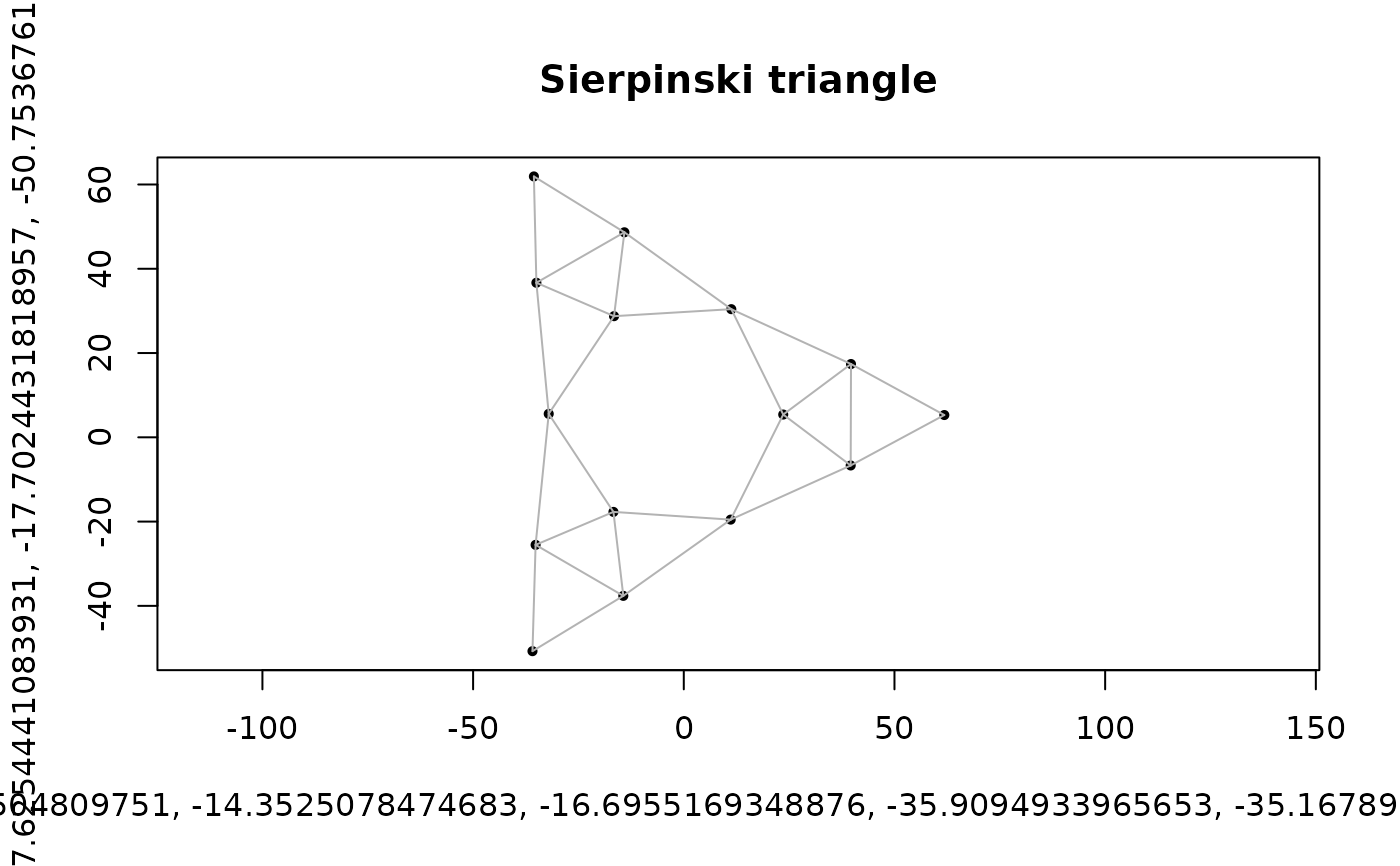
edges.sierpinski.triangle(level = 2)
edges.sierpinski.tetrahedron(level = 2)
edges.sierpinski.carpet(level = 2)Arguments
- n
Number of vertices.
- h
Number of rows.
- w
Number of columns. Defaults to
h.- connectivity
Mesh neighborhood rule.
"orthogonal"keeps the 4-neighbor grid;"diagonal"also adds both diagonals of every unit square.- keep
Logical or numeric occupancy matrix. Non-zero entries are kept.
- base
Base polyhedron for
edges.triangulated.polyhedron(). One of"tetrahedron","octahedron", or"icosahedron".- level
Recursion depth. For
edges.recursive.mask.grid(),edges.recursive.cube.mask(),edges.vicsek(),edges.menger.sponge(), andedges.sierpinski.carpet(),levelmust be at least 1;edges.recursive.triangle.mask(),edges.recursive.tetrahedron.mask(), andedges.triangulated.polyhedron()also allowlevel = 0.- layers
Number of non-center radial layers for
edges.irregular.ball()and number of inner-to-outer layers foredges.irregular.shell().- outer_radius
Positive outer boundary radius for
edges.triangulated.annulus()andedges.triangulated.pair.of.pants().- radial_irregularity
Within-ring radial irregularity level for
edges.irregular.annulus().- layer_twist
Finite z-axis twist applied across radial layers in
edges.irregular.ball()andedges.irregular.shell().- inner_radius
Positive inner annulus radius for
edges.triangulated.annulus().- major_rings
Number of cyclic major rings for
edges.irregular.torus().- tube_count
Approximate number of vertices around each minor cycle for
edges.irregular.torus()and around each tube-like loop foredges.irregular.double.torus().- count_irregularity
Irregularity level for sample counts in
edges.irregular.torus(),edges.irregular.annulus(),edges.irregular.pair.of.pants(),edges.irregular.double.torus(), andedges.irregular.sphere().- major_irregularity
Major-angle ring-spacing irregularity level for
edges.irregular.torus().- phase_twist
Angular phase offset used to desynchronize neighboring rings, slice samples, or latitude bands in the irregular torus, irregular annulus, irregular pair-of-pants, irregular double torus, and irregular sphere families.
- rings
Number of concentric sample rings for
edges.irregular.annulus().- outer_count
Approximate number of vertices on the outer boundary for
edges.irregular.annulus()and across the widest slices foredges.irregular.pair.of.pants().- slices
Number of horizontal sample slices for
edges.irregular.pair.of.pants().- hole_radius
Positive radius of each interior hole for
edges.triangulated.pair.of.pants().- hole_offset
Positive horizontal offset of the two hole centers for
edges.triangulated.pair.of.pants().- hole_height
Shared vertical coordinate of the two hole centers for
edges.triangulated.pair.of.pants().- vertical_irregularity
Slice-spacing irregularity level for
edges.irregular.pair.of.pants().- branch_length
Half-length of the three-loop central region for
edges.irregular.double.torus().- branch_offset
Offset of the outer loop centers from the middle loop for
edges.irregular.double.torus().- tube_radius
Baseline radius of each tube-like loop for
edges.irregular.double.torus().- transition_width
Width of the single-loop to three-loop transition regions for
edges.irregular.double.torus().- axial_irregularity
Slice-spacing irregularity level for
edges.irregular.double.torus().- bands
Number of non-pole latitude bands for
edges.irregular.sphere().- equator_count
Approximate number of vertices near the equator for
edges.irregular.sphere().- lat_irregularity
Latitude-band spacing irregularity level for
edges.irregular.sphere().- side
Number of lattice points along each cube edge.
- k
Branching factor.
- depth
Number of levels below the root.
- mask
Keep-mask describing which recursive cells are retained. For
edges.recursive.mask.grid(),maskmust be a square logical or numeric keep-matrix whose non-zero entries are kept at each recursive subdivision step. Foredges.recursive.triangle.mask(),maskmust instead be a four-entry vector inleft,right,top,centerorder, and foredges.recursive.tetrahedron.mask(),maskmust be a four-entry vector inbase_left,base_right,base_back,apexorder. Foredges.recursive.cube.mask(),maskmust be a cubic logical or numeric keep-array whose non-zero entries are kept at each recursive subdivision step.- resolution
Positive lattice-resolution control used by
edges.triangulated.annulus()andedges.triangulated.pair.of.pants().- tunnel_width
Width of each removed tunnel band in
edges.cube.periodic.tunnels().- tunnel_period
Spacing between successive tunnel bands in
edges.cube.periodic.tunnels().- tunnel_offset
Starting index of the first tunnel band in
edges.cube.periodic.tunnels().- cavity_size
Side length of the larger interior cavity block in
edges.cube.asymmetric.cavities().- pocket_size
Side length of the smaller secondary cavity block in
edges.cube.asymmetric.cavities().- channel_width
Width of each removed channel in
edges.cube.channel.network().
Value
A two-column integer matrix of undirected edges. Vertex labels are consecutive integers starting at 1.
Details
The occupied-grid, recursive masked-grid, and Sierpinski families are
exposed explicitly rather than overloading a single generator with
layout-dimension-dependent behavior: edges.occupied.mesh()
builds a finite perforated-mesh family from an occupancy matrix,
edges.recursive.mask.grid() builds a generic square-mask
family, edges.recursive.triangle.mask() builds a generic
triangle-mask family, edges.recursive.tetrahedron.mask()
builds a generic tetrahedron-mask family,
edges.recursive.cube.mask() builds a generic cube-mask
family, edges.vicsek() builds the connected axial-cross
variant, edges.menger.sponge() builds the classic cubical
sponge variant, edges.triangulated.polyhedron() builds a
generic irregular triangulated-surface family,
edges.sierpinski.triangle() builds the 2-simplex family,
edges.sierpinski.tetrahedron() builds the 3-simplex family,
and edges.sierpinski.carpet() builds a 2D cell-adjacency
carpet graph.
Functions
edges.path(): Path graph onnvertices.edges.cycle(): Cycle graph onnvertices.edges.mesh(): Rectangular grid graph withhrows andwcolumns.edges.occupied.mesh(): Rectangular occupied-grid graph whose vertices are kept cells and whose edges connect orthogonally adjacent kept cells. Withconnectivity = "diagonal", both diagonals are added for every fully occupied 2-by-2 block.edges.cylinder(): Cylindrical grid graph withhrows and wrapped widthw.edges.torus(): Toroidal grid graph with wrapped height and width.edges.irregular.ball(): Deterministically irregular tetrahedralized ball graph built from nested subdivided polyhedral shells connected by a layered prism-to-tetrahedra edge pattern.edges.irregular.shell(): Deterministically irregular tetrahedralized shell graph built from nested subdivided polyhedral shells connected by a layered prism-to-tetrahedra edge pattern.edges.irregular.torus(): Deterministically irregular torus graph built from major-cycle rings with varying sample counts and stitched into a locally triangulated closed surface.edges.sphere(): Sphere surface graph withhlatitude levels (including the poles) and wrapped longitudew.edges.irregular.annulus(): Deterministically irregular annulus graph built from concentric sample rings with varying sample counts and stitched into a locally triangulated surface-with-boundary graph.edges.irregular.pair.of.pants(): Deterministically irregular pair-of-pants graph built from horizontal slice intervals with varying sample counts and stitched into a locally triangulated surface-with-boundary graph.edges.irregular.double.torus(): Deterministically irregular double-torus graph built from cyclic slices whose cross-sections follow a `1 -> 3 -> 1` loop transition between two poles.edges.irregular.sphere(): Deterministically irregular sphere graph built from latitude bands with varying sample counts and stitched into a locally triangulated closed surface.edges.cube(): Cube surface graph on the boundary of aside x side x sidelattice.edges.kary.tree(): Fullk-ary tree of depthdepth.edges.recursive.mask.grid(): Recursively refined square-mask grid graph whose vertices are occupied cells and whose edges connect orthogonally adjacent cells.edges.recursive.triangle.mask(): Recursively refined triangle-mask graph whose vertices are the retained subdivision vertices of an equilateral triangle.edges.recursive.tetrahedron.mask(): Recursively refined tetrahedron-mask graph whose vertices are the retained subdivision vertices of a tetrahedron.edges.recursive.cube.mask(): Recursively refined cube-mask graph whose vertices are occupied subcubes and whose edges connect face-adjacent occupied cells.edges.triangulated.polyhedron(): Triangulated closed-surface graph obtained by repeatedly splitting the triangular faces of a tetrahedron, octahedron, or icosahedron.edges.triangulated.annulus(): Triangulated annulus graph obtained by clipping a regular triangular lattice to the region between two concentric circles.edges.triangulated.pair.of.pants(): Triangulated pair-of-pants graph obtained by clipping a regular triangular lattice to a disk with two interior circular holes.edges.vicsek(): Connected Vicsek-style cross family derived from a3 x 3axial-cross keep-mask.edges.menger.sponge(): Classic Menger-sponge cubical cell-adjacency graph derived from the3 x 3 x 3keep-mask that removes the center cube and the six face-center cubes at each recursion step.edges.cube.periodic.tunnels(): Periodic cubical tunnel family derived from a repeated tunnel-band keep-mask. The classic Menger sponge appears as theside = 3,tunnel_width = 1special case.edges.cube.asymmetric.cavities(): Cubical porous family with two offset interior cavity blocks repeated recursively.edges.cube.channel.network(): Cubical porous family with a deterministic branched channel network carved through each recursive block.edges.sierpinski.triangle(): Two-dimensional Sierpinski triangle graph at recursion depthlevel.edges.sierpinski.tetrahedron(): Three-dimensional tetrahedral Sierpinski graph at recursion depthlevel.edges.sierpinski.carpet(): Two-dimensional Sierpinski carpet graph whose vertices are occupied cells and whose edges connect orthogonally adjacent cells.
Examples
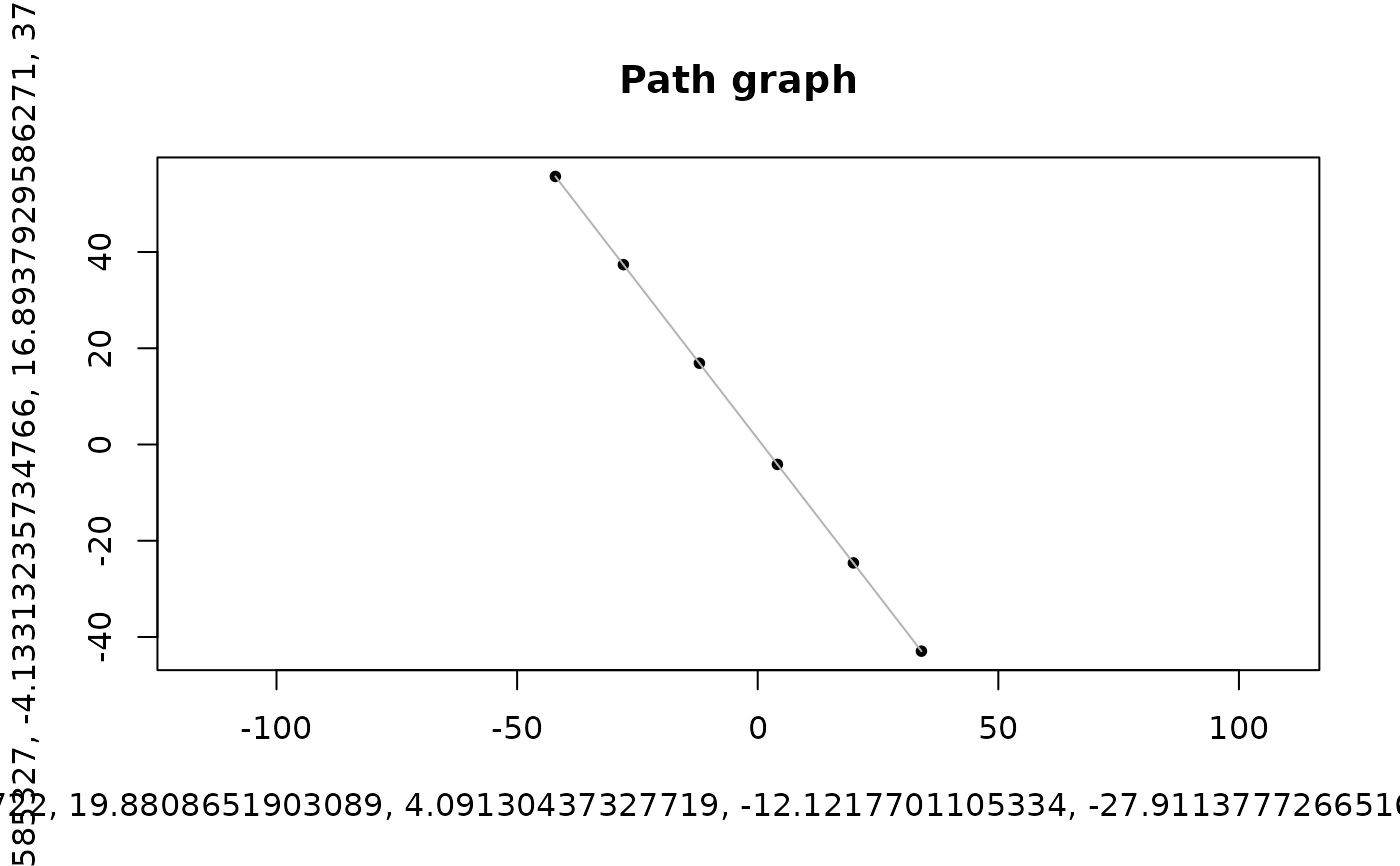
edges <- edges.path(6)
coords <- grip(edges, n = 6, dim = 2, seed = 1)
plot.layout(coords, edges, main = "Path graph", pch = 16, cex = 0.8)
edges <- edges.sierpinski.triangle(2)
n <- max(edges)
coords <- grip(edges, n = n, dim = 2,
placement = "circle",
seed = 1)
plot.layout(coords, edges, main = "Sierpinski triangle", pch = 16, cex = 0.7)